Completed
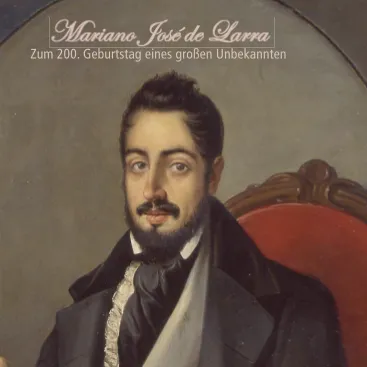
Mariano José de Larra (1809–37) is regarded as one of the most significant essayists in Spanish literature. His satirical and critical studies of social life, political polemics and theatre reviews are compared to the essays and feuilletons of Heinrich Heine. “Larra is a unique phenomenon,” says publisher Heinrich Berenberg, “and, together with his contemporaries Heine, Hazlitt, Lamb and de Quincey, forms a quintet in Europe that has raised the literary essay to unparalleled heights.” In Germany, however, Larra has remained unknown and undiscovered to this day. Only four of his essays appear in German anthologies; a standalone edition of his works has yet to be published in German.
To mark the author’s 200th birthday on 24 March 2009, Lettrétage organised two readings under the theme “On the 200th birthday of the Spanish essayist Mariano José de Larra: Discovering a great stranger”, with the aim of honouring his life and work and introducing him to the public.
On 24 March 2009, the first anniversary event took place under the title "Der arme Schwätzer" (The Poor Waffler): on this evening, Larra’s essays „Das Cafe“ (The Café) and „Alle Welt trägt Masken, das ganze Jahr herrscht Karneval“ (Everyone Wears Masks, It's Carnival All Year Round) were read for the first time; these had been translated into German especially for the anniversary event by Stefan Degenkolbe and Katharina Deloglu.
On 27 March 2009, the second anniversary reading, "Die satirischen Kobolde: Larra & Heine" (The Satirical Goblins: Larra & Heine), took place in cooperation with the Heinrich Heine Society (Berlin-Brandenburg): Larra and Heine, modern Europeans of the 19th century, were kindred spirits, and German Romanists sometimes refer to Larra as the “Spanish Heine”. The Lettrétage made possible what has never before occurred in literary history – an encounter between the authors through their texts, a dialogue from pen to pen that brings to life what connects the “satirical goblins” (one of Larra’s pseudonyms).
The following people read and spoke at both events: Denis Abrahams (actor), Javier Sánchez-Arjona (literary scholar) and Katharina Deloglu (project coordinator and presenter).
Mariano José de Larra (born in Madrid in 1809, died in 1837) began studying medicine in Spain, but later dropped out. As a cosmopolitan, aristocratic dandy, he wrote his ‘artículos’ in the capital’s literary circles, led an erratic life as an editor of various magazines, and also shifted his political allegiance from a polemical progressive to a moderate liberal. With a healthy dose of self-irony, he wrote for various newspapers under the pseudonyms ‘satirical goblin’ and ‘poor waffler’.
Published German translations of Larra's work up until now: „Brief an Andreas“, 1957 (Horst Baader); „Der Altkastilier“ und „Kommen Sie morgen wieder“, 1964 (Egon Hartmann); „In diesem Land“, 1987 (Erna Brandenberger)
The anniversary events were sponsored by the Spanish Ministry of Culture and the Berlin-based Rosenbaum Foundation.