Climatic Subjects
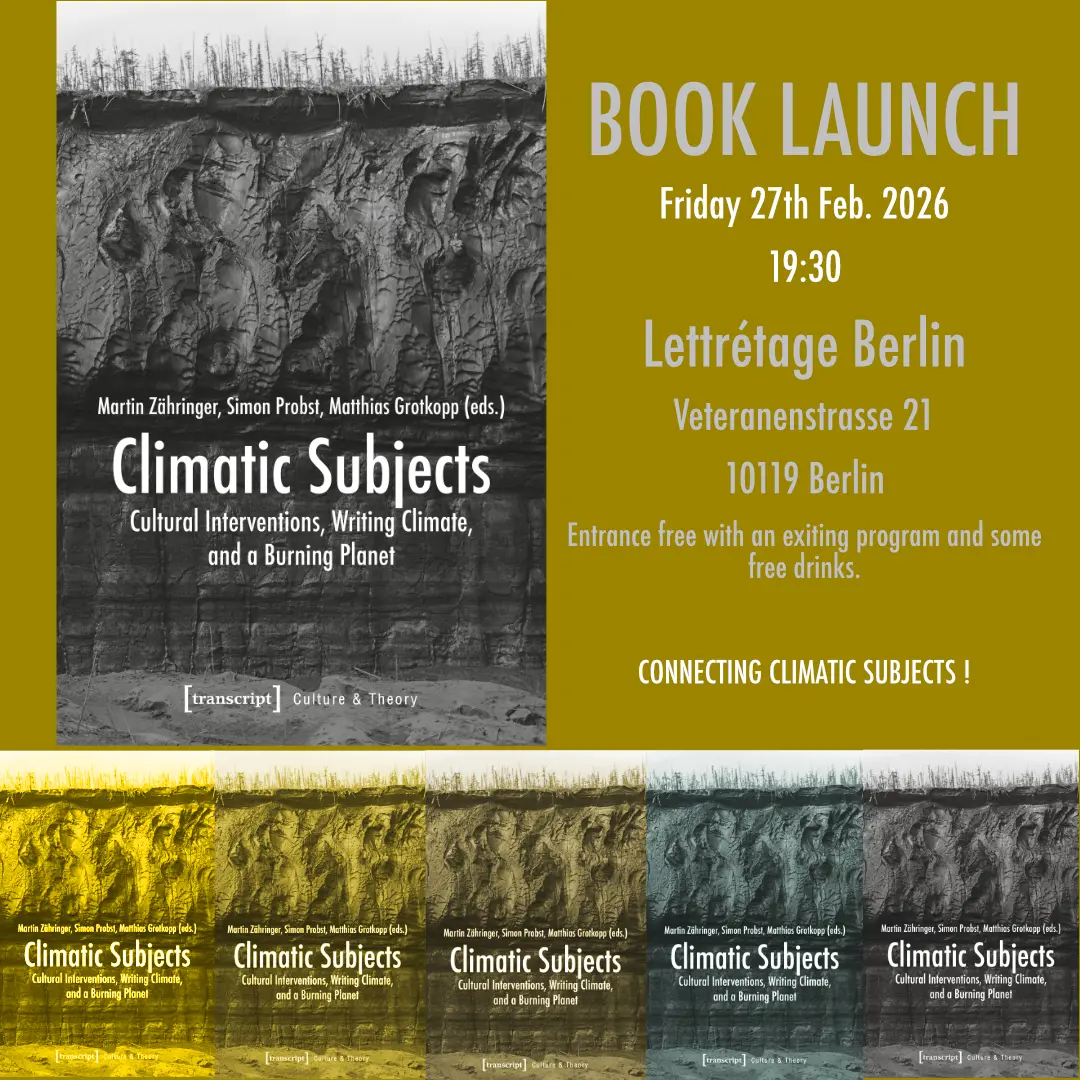

We invite you to a climate cultures evening with spoken words and visuals, bodies and sounds, discussions and drinks. The main occasion is the release of our new publication “Climatic Subjects“, a multi-genre anthology edited in the wider context of the Climate Culture network e.V. together with University Vechta and FU Berlin. We proudly present you to some of our exiting contributors from a wide range of climate cultural thinking, writing, photographing, dancing, and filming.
Climatic Subjects. Who are they? Where are they? What are they doing? How can literature, together with science, arts and media, merging direct action with aesthetics, contribute to a new and productive view of what we would like to call Climate Culture? This night we knit a net with: performer Vera Shchelkina, climate journalist Angelina Davydova, poet and writer Zara Zerbe, writers and sound poets Michaela Vieser & Isaac Yuen, film scholar Matthias Grotkopp, cultural geograph Mike Hulme, journalist and media scholar Lebogang Neidhardt-Mokoena, and some ‚best of‘ from Climate Cultures festivals we had in Berlin.
It’s true: We do have good solutions, wider horizons, and exciting creative and powerful Climatic Subjects working on a better world. But it’s also true that there are powerful anti-climatic subjects in this world, turning back the clock toward a disastrous fossil fuel catastrophe. In this sense our evening could become a rallying cry: Climatic Subjects of the world, unite!
Angelina Davydova
Angelina Davydova is an environmental and climate journalist and essayist, based in Berlin. She is a fellow at the Institute for Global Reconstitution, climate projects expert at Dialogue for Understanding e. V, co-host of the podcast The Eurasian Climate Brief. She has been an observer of the UN climate negotiations (UNFCCC) since 2008. She is a councillor with the World Future Council.
Matthias Grotkopp
Matthias Grotkopp is Assistant Professor for Digital Film Studies at the Seminar for Film Studies at Freie Universität Berlin. He is the author of Cinematic Poetics of Guilt. Audiovisual Accusation as a Mode of Commonality (Berlin/Boston: De Gruyter 2021). His research interests include the audiovisuality of the climate crisis and ecological disaster, genre theory and the relation of politics and poetics, the films of the so-called Berlin School as well as digital methods of film analysis.
Mike Hulme
Mike Hulme is professor of human geography at the University of Cambridge. His work illuminates the numerous ways in which the idea of climate change is deployed in public, political, religious and scientific discourse. He is the author of 12 books on climate change including, most recently, Climate Change Isn’t Everything (Polity, 2023). He is the author of the widely acclaimed Why We Disagree About Climate Change (Cambridge University Press, 2009) and from 2000 to 2007 was the Founding Director of the Tyndall Centre for Climate Change Research.
Lebogang Neidhardt-Mokoena
Lebogang Neidhardt-Mokoena is an emerging researcher in media and journalism studies with an interest in visual environmental communication. Lebogang is a trained journalist. Their contribution to this book emerged from a project they stated within the frame of the Alexander von Humboldt’s German Chancellor Fellowship for Prospective Leaders (2022–2023). Lebogang holds a Master of Arts in Journalism from the University of Johannesburg, South Africa.
Vera Shchelkina
Vera Shchelkina is a dance artist, somatic movement educator graduate from Somatic Academy Berlin, master student of MA Choreography at HZT, Hochschule für Schauspielkunst "Ernst Busch", facilitator and curator for professional and non-professional dance and performance programs "Contemporary Dance for Deaf Community" in GES-2, "Summer School for Performance in HFBK" and others. Their main areas of artistic interest are: humans as a set of environments and consciousnesses, touch as a gateway to the diversity of the body, perception as an instrument of movement, self-image, a gateway to non-personal experience.
Michaela Vieser
Michaela Vieser is a Berlin-based award-winning nature writer of eleven books, radio features and TV documentaries. In her work, Vieser seeks to explore liminal spaces through science, sensing, and sense-making, playing with narrative, language, and research. She was selected as a nature writer-in-residence at the Jan-Michalski Foundation in 2019, won the German Prize for Nature Writing Fellowship in 2021, and was awarded the Wave Writer Fellowship for the Okeanos Foundation for the Sea for two consecutive years from 2022-2023.
Isaac Yuen
Isaac Yuen, a first-generation Hong Kong-Canadian, pens essays and short fiction exploring the intersection of nature, culture, and identity. He is the author of the essay collection Utter, Earth: Advice on Living in a More-than-Human World and the co-author of The Sound Atlas: A Guide to Strange Sounds Across Landscape and Imagination with Michaela Vieser. Recipient of a Pushcart Prize in literature with a Master’s in environmental education and communication, Isaac has been awarded residencies and fellowships in Switzerland, Germany, and France.
Zara Zerbe
Zara Zerbe is a fiction writer based in Kiel. In her literary works, she explores the intersections between ecological topics, social justice, utopian/dystopian futures and magic realism. She studied literature and media studies and has been active in Kiel’s literary scene since 2012—as co-editor of the magazine Der Schnipsel and host of the reading stage Lesebühne FederKiel. Her short story Limbus (SuKuLTuR, 2020) won the “Neue Prosa Schleswig-Holstein” award in 2018. In 2021, she published the novella Das Orakel von Bad Meisenfeld (Stirnholz Verlag), followed in 2024 by her debut novel Phytopia Plus (Verbrecher Verlag), which received the „Phantastikpreis der Stadt Wetzlar“ and was also nominated for the Kurd Laßwitz Award. In 2022, she was honoured with the Art Promotion Award of Schleswig-Holstein.